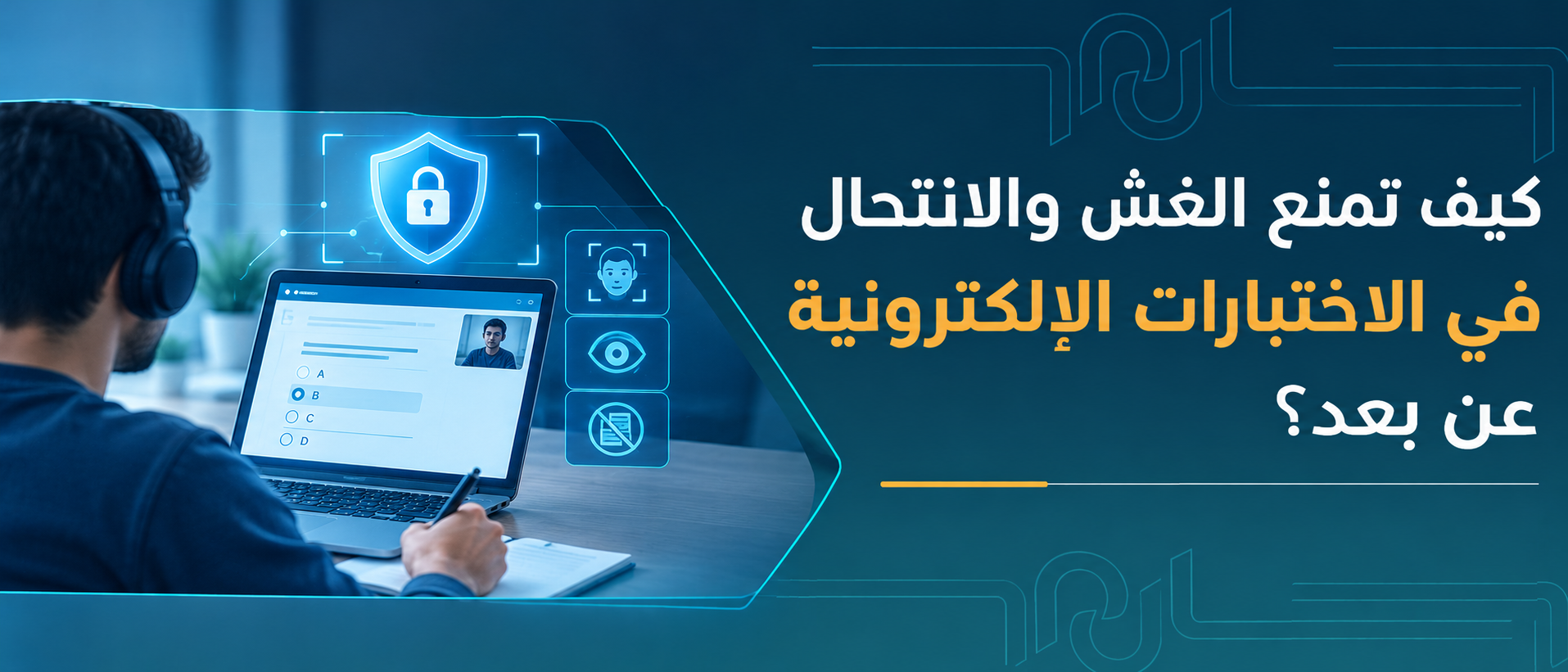
Remote online tests have allowed companies and educational bodies to measure candidates’ skills from anywhere, at lower cost and in less time than in-person tests. But this flexibility opens the door to legitimate concerns: was the person who answered the candidate themselves? Did they use sources that were not permitted? The reliability of test results depends on the answers to these questions. In this article, we explain the forms of cheating and impersonation in remote tests, and offer practical ways to prevent them before, during, and after the test, while respecting candidates’ rights and privacy.
Why Do Cheating and Impersonation Happen in Remote Tests?
The absence of a direct proctor and the ease of reaching information and people make violations easier. The most common forms are:
• Impersonation: Someone other than the registered name takes the test.
• Help from a person present: Someone sits with the candidate and helps or feeds them answers.
• Unauthorized sources: Books, notes, websites, or side chats during the test.
• AI tools: Copying the question and pasting it into a tool that generates the answer automatically.
• Multiple devices and screens: Using a phone or a second screen to search outside the proctoring field of view.
• Question leaks: Photographing the test and sharing it with later candidates.
• Collusion between candidates: Exchanging answers over messaging apps during the session.
What Is the Difference Between Cheating and Impersonation?
• Cheating: The candidate getting illegitimate help during the test itself, such as looking at a source or asking another person.
• Impersonation: One person taking the test in another person’s name, so the problem here is the identity of the person taking the test, not how they answered.
• Their impact: Both make the result fail to reflect the candidate’s real competence, wrong honest candidates, and lead to mistaken hiring or promotion decisions.
This distinction matters because each type has a different solution, as will be seen below.
There Is No Single Tool: Build a Multi-Layer System
No single tool completely prevents cheating, because anyone who wants to get around a measure will find a way. The better approach is to apply integrated layers that raise the cost of cheating and reduce the motive for it:
• Before the test: Verifying identity, designing the test, and announcing the rules.
• During the test: Proctoring, restricting the test environment, and detecting violations.
• After the test: Analyzing results, reviewing suspicious cases, and follow-up verification when needed.
First: Before the Test
Verifying the Candidate’s Identity
This is the most important step for preventing impersonation, and it includes:
• Linking the test to a personal account: A unique login link for each candidate that cannot be used by anyone else, with a block on using it more than once.
• Matching the ID document to the face: The candidate photographs their ID and face, and the match is made automatically or by human review.
• Additional verification: A verification code sent to the candidate’s registered phone or email.
• Capturing a reference photo: Used for comparison later if doubt arises during or after the test.
Designing a Test That Reduces Opportunities to Cheat
• A large question bank: The system picks different questions for each candidate at the same level.
• Random order: Questions and options appear in a different order for each candidate, making it hard to share answers.
• A time limit per question: It reduces the time available to search or consult.
• Blocking return to previous questions: It prevents changing answers after seeing what comes next.
• Applied questions linked to work situations: Harder to copy than direct recall questions.
• Updating questions regularly: Questions that repeat for years become known and publicly available.
Announcing the Rules and Consequences in Advance
• A written integrity policy: It explains what is allowed and what is prohibited during the test.
• A candidate acknowledgment: The candidate agrees to the rules and to proctoring before starting.
• Clear consequences: The actions that follow a violation are announced, such as canceling the result or retaking the test.
• Setup instructions: They explain the device, browser, lighting, and place required for the test.
• A technical trial run in advance: A check of the device and connection before the test reduces problems that might be wrongly read as cheating.
Second: During the Test
Restricting the Test Environment
• A locked-down browser: It prevents opening other windows, tabs, or applications during the session.
• Blocking copy, paste, printing, and screenshots: They limit question leaks and copying to outside tools.
• Detecting window switching: The system records when the candidate left the test screen and how many times.
• Single-device enforcement: An alert on attempts to log in from more than one device or connection address at the same time.
Proctoring the Candidate During the Session
• Camera proctoring: It confirms the candidate stays alone in front of the screen throughout the test.
• Screen and audio recording: Saved for review when there is doubt, and not used for any other purpose.
• Room scan by camera: The candidate is asked to show their desk and surroundings before starting.
• Smart alerts with human review: The system flags things such as more than one person present or a missing face, but the decision about them is not made automatically.
• A live proctor: Monitors sessions remotely in highly sensitive tests and steps in when needed.
Third: After the Test
Analyzing Results and Candidate Behavior
• Abnormal answer time: Answering a hard question in a few seconds, or a long delay on an easy one, may indicate outside help.
• Matching answers: Comparing answer patterns between candidates reveals unusual similarity, especially identical mistakes.
• Sharp performance differences: A very high result that does not match the candidate’s performance in other stages calls for review.
• Violation log: The number of times the screen was left, windows were switched, and proctoring alerts were raised.
• Analyzing written answers: Detecting similarity to published sources or to other candidates’ answers.
Reviewing Suspected Cases
• Human review of every case: A candidate’s result is not canceled because of an automated alert alone.
• Allowing the right to explain: The candidate is given a chance to explain, as a technical fault or an emergency may lie behind the case.
• Documenting the decision: The reason for the decision and the evidence relied on are recorded, so that procedures are fair and reviewable.
• A short retest: When in doubt, a short retest under direct proctoring or a confirmation interview can show whether the candidate’s level matches their result.
How Do You Design Questions That Are Hard to Cheat On?
Question design is itself one of the strongest forms of prevention, because it tackles the problem at its root instead of policing it:
• Scenario and situational questions: They ask the candidate to analyze a practical case and make a decision, and a ready-made answer is harder to find.
• Questions built on a specific context: They rely on data or text shown within the test itself.
• Questions that require explaining reasons: The candidate is asked to justify their answer, which reveals real understanding.
• Adaptive tests: The level of the next question changes with the candidate’s answer, so not all candidates see the same questions.
• A mix of question types: Multiple choice, essay questions, and practical exercises, to reduce reliance on a single format.
• Avoiding pure recall questions: A fact that appears instantly in any search engine does not measure real competence.
Artificial Intelligence and Cheating on Tests
Generative AI tools have made it easier to answer many written questions. To deal with that:
• Do not rely on generic questions: Questions any language model answers easily do not separate candidates.
• Tie questions to a specific work context: Such as a case from your company or sector.
• Add an oral follow-up: A short interview after the test asks the candidate about the details of their answers.
• Watch writing patterns: A sudden change in writing style or similar phrasing across several answers may call for review.
• Define what is allowed: Some jobs accept the use of these tools at work, so make the test measure the ability to use them wisely if that is part of the job.
How Do You Balance Integrity, Privacy, and Fairness?
Strong proctoring protects test integrity, but it may burden candidates and touch their personal data. For this reason:
• Ask for explicit consent: The candidate knows what is recorded and why before they begin.
• Collect the minimum data possible: Record only what serves the purpose and do not keep it longer than necessary.
• Set a retention period for recordings: Delete them once they are no longer needed, and comply with the regulations in force in the Kingdom on personal data protection.
• Consider candidates’ circumstances: Some live in crowded places, have a weak connection, or need special arrangements, and this does not mean they are cheating.
• Provide alternatives when needed: Such as a test at a designated center for those who cannot test from home.
• Do not leave the decision to the machine alone: Every accusation of cheating needs evidence and human review.
• Test proctoring tools for bias: Make sure alerts do not fall at a higher rate on certain groups because of skin tone, lighting, or disability.
A Quick Comparison of Cheating Prevention Methods
• Identity verification: Prevents impersonation, needs documents and a camera, and suits all important tests.
• Locked-down browser: Prevents opening other sources on the same device, but does not prevent external devices.
• Camera proctoring: Detects human help and extra devices, but raises privacy concerns.
• Question bank and random order: Reduces collusion and question leaks at low cost.
• Post-test analysis: Detects abnormal patterns, but needs human review.
• Confirmation interview: Checks the candidate’s actual level, but takes extra time.
Practical Steps for Applying an Anti-Cheating System
• Define the test’s sensitivity level: A test that determines a hiring or promotion decision needs more protection than a training test.
• Choose measures that fit that level: Do not impose heavy proctoring on a simple test.
• Design the questions carefully: Start with applied questions and a large question bank.
• Explain the rules to candidates: In the test invitation and before it begins.
• Pilot the system in advance: Make sure it works on different devices and connections.
• Set a mechanism for reviewing violations: Who reviews, within how many days, and what the decision criteria are.
• Evaluate the system periodically: Review false-alert rates and candidate complaints, and improve the procedures.
Common Mistakes That Weaken Cheating Prevention
• Relying on a single tool: Proctoring alone without good question design is not enough.
• Excessive proctoring without justification: It harms the candidate experience and draws complaints without a proportionate benefit.
• Making an automated decision without review: It leads to wronging innocent candidates.
• Neglecting to explain the rules: A candidate who does not know the rule may break it unintentionally.
• Ignoring the technical side: Connection and device failures are sometimes misread as cheating.
• Leaving questions without updates: They leak over time and lose their value.
How Does the Al-Bayan Assessment Platform Help You?
An online testing system can be supported by identity verification measures, proctoring, and separate work environments for each organization, within the Al-Bayan Assessment platform, which brings psychological tests, ability tests, and reports together in one place. To help design tests and set integrity policies suited to your jobs, you can contact the assessment team.
Frequently Asked Questions
Can cheating in remote tests be prevented completely?
It cannot be guaranteed absolutely, but combining identity verification, question design, proctoring, and post-test analysis greatly raises the cost of cheating and reduces its chances.
What is the best way to prevent impersonation?
Identity verification by matching an official document with the candidate’s face, linking the test to a personal account, and being able to re-confirm identity at any stage, or through a short confirmation interview.
Is camera proctoring necessary for every test?
Not always. Tests that affect important decisions, such as hiring, deserve stronger proctoring, while training or low-risk tests are fine with lighter measures.
How do I handle a candidate I suspect of cheating?
Review the evidence with a human, give them a chance to explain, document the decision, and consider a short confirmation test before taking final action. Do not rely on an automated alert alone.
Do remote tests protect candidates’ privacy?
It depends on the organization’s policy and the system used. You should obtain the candidate’s consent, define the data collected and how long it is kept, and comply with the personal data protection regulations in force.
Preventing cheating and impersonation in remote online tests needs an integrated system, not a single tool: identity verification before the test, carefully designed questions, balanced proctoring during it, and analysis and human review after it, with respect for candidates’ privacy and fairness of procedures. If you want to build a reliable testing system for your jobs, contact the Al-Bayan Assessment team and book a consultation that helps you choose the best solution.