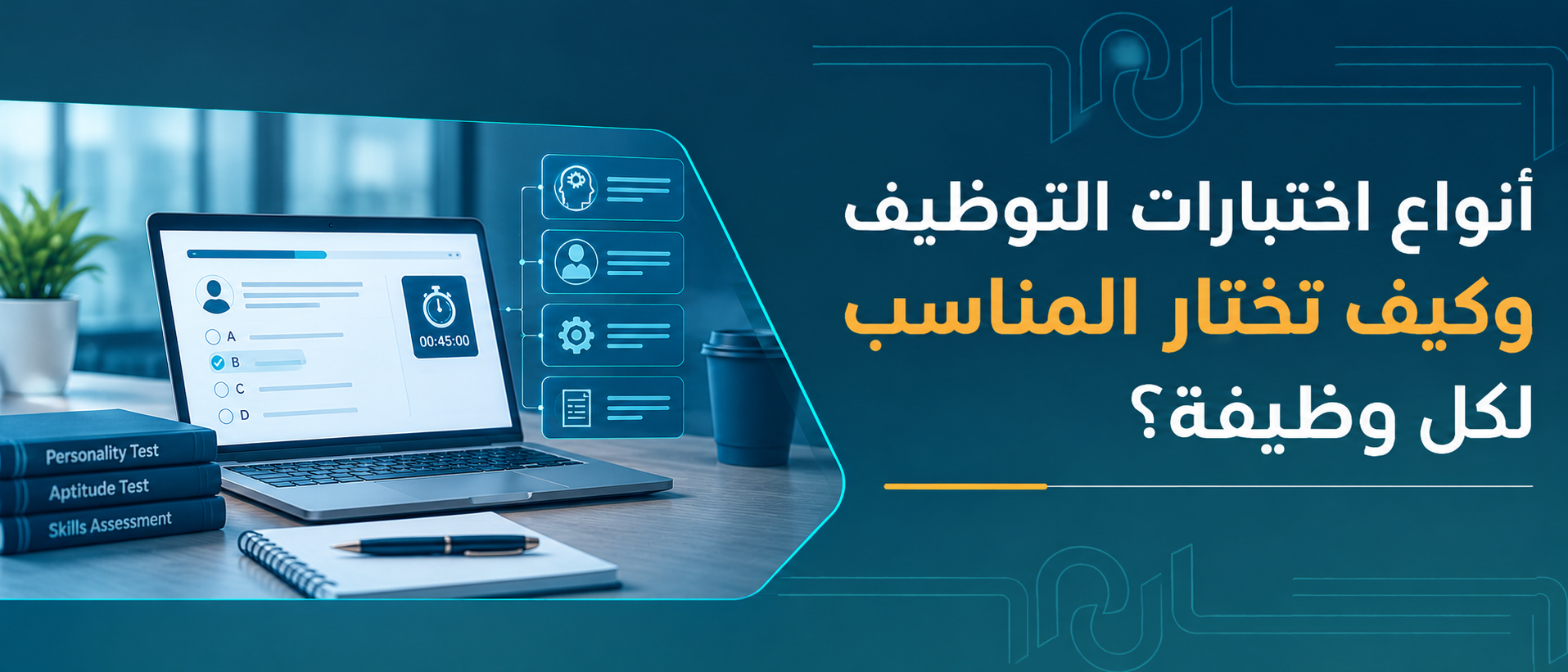
Many hiring decisions are built on a résumé and a short interview, which may reveal what the candidate said about themselves without revealing what they can actually do. This is where employment tests come in, giving the organization objective data on a candidate’s abilities, traits, and skills. But the practical question is not “should we use a test or not?” but “which test suits this particular job?” Choosing the wrong type wastes time and may lead to a mistaken decision. In this article, we present the main types of employment tests, what each one measures, and then explain the steps for choosing the right one for each job.
What Are Employment Tests and Why Are They Used?
Employment tests are structured tools that measure a specific aspect of a candidate’s competence in a standardized way that allows candidates to be compared with one another. Organizations use them for reasons that include:
• Objectivity: They reduce the influence of personal impression on the decision.
• Predicting performance: Well-designed tests help predict a candidate’s success in the role.
• Fast screening: They shorten the time spent reviewing large numbers of applicants.
• Fairness: Everyone is held to the same criteria.
• A justifiable decision: The organization has data to explain why one candidate was chosen over another.
Types of Employment Tests
Cognitive Ability Tests
They measure a candidate’s ability to think, learn new tasks, and solve problems. Their forms include:
• Numerical ability: Understanding numbers, tables, and ratios.
• Verbal ability: Understanding texts and extracting information from them.
• Logical reasoning: Discovering patterns and relationships through abstract thinking.
• Accuracy and speed: Checking data and processing it quickly.
They suit most jobs, especially those that require analysis and quick learning, and they are useful when hiring less experienced people who do not have many work records.
Psychological and Personality Tests
They measure interests, personality traits, and work style, such as:
• Discipline and organization.
• Openness to experience and change.
• Cooperation with others.
• Emotional stability and handling pressure.
• A tendency toward extraversion or toward working alone.
It is important here that a psychological test does not divide people into pass and fail, but describes patterns that suit different environments and roles. A specialist should link its results to the job’s requirements rather than use them as a standalone verdict.
Competency and Situational Judgment Tests
They present the candidate with realistic work situations and ask them to choose the most suitable action or rank the options. They are:
• Directly tied to the required competencies, such as customer service and decision-making.
• Closer to the reality of work than theoretical questions.
• Suitable for both less experienced and seasoned candidates.
Job Knowledge and Technical Skills Tests
They measure what the candidate knows in their field of work, such as accounting, programming, marketing, human resources, or regulatory systems, and they suit:
• Specialized jobs where a specific level of knowledge is needed from day one.
• Verifying the accuracy of the experience stated in the résumé.
They are not enough on their own to judge a candidate, because knowing something and being able to apply it are two different things.
Language Tests
They measure reading, writing, speaking, and listening skills in Arabic, English, or other languages, and they suit:
• Jobs that depend on correspondence, reports, and content.
• Customer service and sales in multilingual environments.
• Jobs that require dealing with international parties.
Work Sample Tests
The candidate is asked to perform a task similar to what they will do in the job, such as writing an article, preparing a report, analyzing data, or designing a plan. Their advantages:
• They are among the strongest indicators because they measure actual performance.
• The quality of the work shows, not a description of it.
• They give the candidate a realistic picture of the role.
But they take more time to design and grade, so they are usually used for the remaining candidates in the final stages.
Simulation Exercises and Assessment Centers
They combine several exercises, such as group discussion, in-basket, and role play, while assessors observe the candidate’s behavior in them. They suit:
• Leadership and supervisory jobs.
• Selecting employees for promotion or leadership preparation programs.
• Sensitive decisions that need a comprehensive picture of the candidate.
For details, read about the assessment center in hiring.
The Structured Interview
An interview based on standardized questions and a defined rating scale that measures behavioral competencies such as communication and problem-solving. It suits almost all jobs, and complements any other test with what numbers do not reveal.
Integrity and Compliance Tests
They measure the tendency to follow rules and be honest at work, and are used in jobs that involve handling money, sensitive data, or oversight decisions. They should be used with caution and with a specialist’s review, because their results must be interpreted carefully.
How Do You Choose the Right Employment Test for Each Job?
Follow these steps in order:
• Analyze the job first: Define the core tasks and the conditions in which the job holder works, and do not start by choosing the test before this step.
• Extract the critical competencies: Choose three to six competencies that truly separate good from poor performance, such as analysis, communication, or discipline.
• Link each competency to a measurement tool: Mental ability is measured by an ability test, behavior with others by an exercise or interview, and technical skill by a knowledge test or a work sample.
• Consider the job level: A beginner needs ability and competency tests, while a leader needs simulation exercises and deeper interviews.
• Determine the number of candidates: Large numbers suit online tests, while small numbers can bear deeper tools and more time.
• Estimate candidate time and cost: A test that is too long pushes good candidates to withdraw.
• Verify the test’s quality: Ask for proof of its validity, reliability, and suitability for the Arabic language and the Saudi environment.
• Pilot the test before adopting it: Apply it to current successful employees and compare the results with their actual performance.
Choosing the Test by Job Type
• Entry-level jobs and recent graduates: Cognitive ability tests, a situational competency test, and a structured interview, because practical experience is limited.
• Sales and customer service: A personality test that measures dealing with others and emotional stability, a situational test of customer scenarios, and a language test when needed.
• Administrative and office jobs: Accuracy and speed tests, verbal and numerical ability, and a computer skills test or a work sample.
• Technical jobs: A job knowledge test and a practical work sample, with an ability test for reasoning and problem-solving.
• Financial and accounting jobs: Strong numerical ability, a job knowledge test, and an integrity and rule-compliance test.
• Supervisory jobs: A leadership competency test, a simulation exercise such as group discussion, and a structured interview.
• Senior leadership jobs: A full assessment center with simulation exercises, a leadership personality test, and an in-depth interview, with a review of past performance.
• Sensitive or oversight jobs: Add an integrity test and background verification according to the organization’s policy and the regulations in force.
How Do You Combine More Than One Test?
One test is not enough for an important hiring decision, because each tool sees one side of the candidate. It is better to build a battery of tests instead of relying on a single tool:
• Initial screening stage: A short ability test or an online situational competency test, to narrow the applicant list quickly.
• In-depth assessment stage: A personality test or a job knowledge test depending on the job.
• Final selection stage: A structured interview, a simulation exercise, or a work sample for the closest candidates.
• Decision stage: The results are gathered in a single report that a specialist reviews, comparing candidates on the competencies required, not on a single score.
It is best not to add stages beyond what the job needs, because too many tests exhaust candidates and lengthen the hiring time.
Criteria of a Good Test
When comparing the available tests, make sure of the following:
• Validity: That the test actually measures what it claims to measure, and its results are linked to job performance.
• Reliability: That results are consistent if measurement is repeated under similar conditions.
• Fairness: The test does not disadvantage a group because of gender, age, or background.
• Language and cultural suitability: Clear Arabic wording and examples suited to the local environment, not a literal translation that confuses the candidate.
• Comparison norms: Tables that compare the candidate’s result with an appropriate group of people, not an absolute score.
• Suitable length: A reasonable time that does not exhaust the candidate or weaken measurement accuracy.
• Clear reports: Results understandable to non-specialists with an interpretation that links them to the job.
• Data protection: Secure storage of candidates’ results and a clear policy on how long they are kept.
Common Mistakes in Choosing Employment Tests
• Choosing the test before analyzing the job: It produces measurement unrelated to what the job needs.
• Relying on a single test: It gives an incomplete picture and raises the risk of error.
• Using a personality test as the final verdict: The result describes a pattern, not a pass or fail.
• Applying one test to all jobs: Sales jobs differ from financial and leadership ones.
• Ignoring test quality: Widely circulated online tests without scientific evidence may mislead the decision.
• Neglecting the candidate experience: Long or unclear tests harm the organization’s image.
• Lack of human review: Results need a specialist to interpret them together with the rest of the information.
• Not following up on results later: The organization does not know whether the test actually predicts employees’ success.
Practical Tips for a Successful Testing Program
• Start with a few jobs: Try the system on specific jobs before rolling it out.
• Tell candidates the purpose: Explain what will be measured and how the results will be used.
• Train those who read the results: Team members who interpret the reports need to understand their limits.
• Provide fair accommodations: Extra time or a suitable method for candidates who need it.
• Document selection decisions: Keep the reason for the decision and its criteria.
• Review the system annually: Compare test results with employees’ performance, and adjust as needed.
How Does the Al-Bayan Assessment Platform Help You?
The Al-Bayan Assessment platform brings together varied measurement tools, including psychological tests, ability tests, leadership competencies, and job knowledge, with reports that interpret results and link them to the job. If you want to choose a battery of tests suited to your jobs, the assessment team can help you define the tools and build the selection path.
Frequently Asked Questions
What are the most commonly used types of employment tests?
The most commonly used are cognitive ability tests, psychological and personality tests, competency and situational judgment tests, job knowledge tests, and structured interviews.
What is the difference between an ability test and a personality test?
An ability test measures what the candidate can do, such as analysis and comprehension, while a personality test describes their inclinations and work style. Ability tests have right and wrong answers, while personality has no pass or fail.
How many tests do I need for each job?
It depends on the sensitivity of the job. Entry-level jobs are usually fine with three tools among a test, an exercise, and an interview, while leadership jobs need a wider battery that includes simulation exercises.
Can a test alone be relied on for a hiring decision?
This is not preferred, because a test is part of the picture. It should be read alongside the résumé, the interview, and past experience, and its results should be reviewed by a specialist.
Are employment tests suitable for small companies?
Yes. A small company can start with a simple battery of an online ability or competency test and a structured interview, then expand the battery as needed.
There is no employment test that suits all jobs, because each type has what it measures and a field it suits. The right choice starts with analyzing the job and defining the critical competencies, then linking each competency to a suitable measurement tool and combining more than one tool, while making sure of the test’s quality and fairness. If you want to build a battery of tests for your jobs, contact the Al-Bayan Assessment team and book a consultation that helps you choose the best fit.